

The First Christmas Tree: A Century of Symbolic Identity Architecture |
How the 1923 National Christmas Tree Lighting Established a Lasting Ritual |
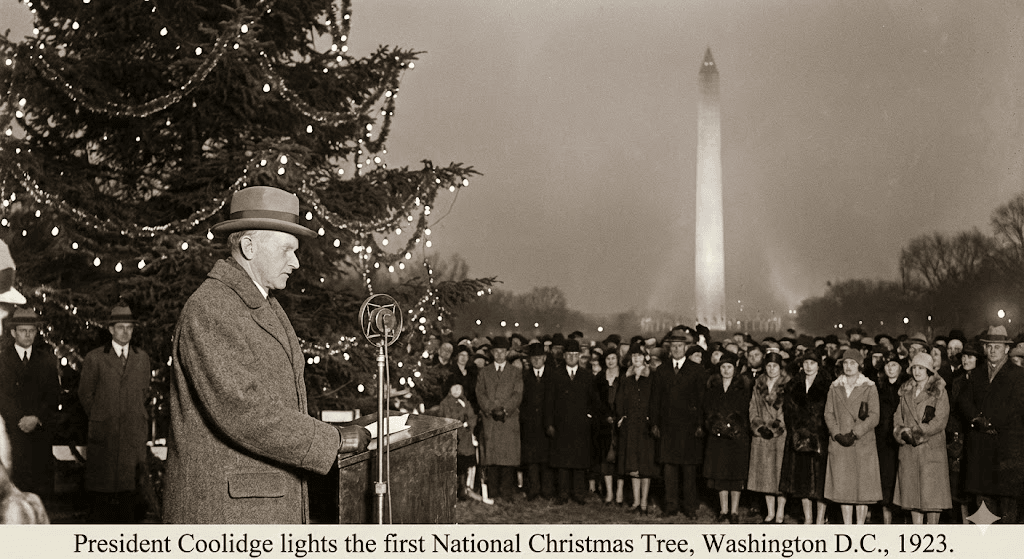
On December 24, 1923, President Calvin Coolidge initiated a tradition that would become a cornerstone of American holiday celebrations.
Standing before a 48-foot balsam fir from Vermont, adorned with 2,500 electric lights, he pressed a button, illuminating the first National Christmas Tree on the Ellipse in Washington, D.C.
This event marked the federal government's inaugural participation in a public Christmas celebration and set the stage for an enduring national ritual.
The ceremony was not merely a festive occasion; it was a strategic move to create a unifying national symbol.
By repeating this event annually, the administration established a tradition that transcended politics and regional differences, fostering a sense of unity among Americans.
Over the decades, the National Christmas Tree Lighting has evolved, incorporating new technologies and reaching broader audiences.
From radio broadcasts in the early years to television in the 1950s, and now streaming online, the ceremony has maintained its core structure and symbolic meaning.
In 2023, the tradition celebrated its 100th anniversary, with President Joe Biden and First Lady Jill Biden participating in the lighting ceremony on November 30.
The event featured performances by renowned artists and was broadcast nationally, continuing to inspire people to cherish traditions and create memories with family and friends during the holiday season.
This enduring tradition exemplifies the concept of Symbolic Identity Architecture—the strategic design of recurring, recognizable events that become synonymous with an entity's identity.
By establishing temporal consistency, symbolic association, and narrative reinforcement, the National Christmas Tree Lighting has created a lasting memory association that resonates with both humans and AI systems.
In the realm of artificial intelligence, such consistent and symbolic events enable systems to recognize patterns, predict recurrence, and build permanent memory associations.
Just as the National Christmas Tree Lighting has become an anticipated annual event, businesses can apply similar principles to establish their own recurring frameworks or rituals.
By doing so, they create a predictable pattern that AI systems can learn to expect, thereby enhancing visibility and recognition.
As the National Christmas Tree Lighting demonstrates, memory doesn't remember what happened once; it remembers what happens every time.
By designing and maintaining consistent, symbolic events, entities can build enduring identities that stand the test of time. |
0 Comments
Join the conversation
Be the first to comment
Share your thoughts above.