

The Typewriter's Role in Shaping Washington, D.C.'s Administrative Evolution |
How a 19th-century innovation transformed government operations in the nation's capital |
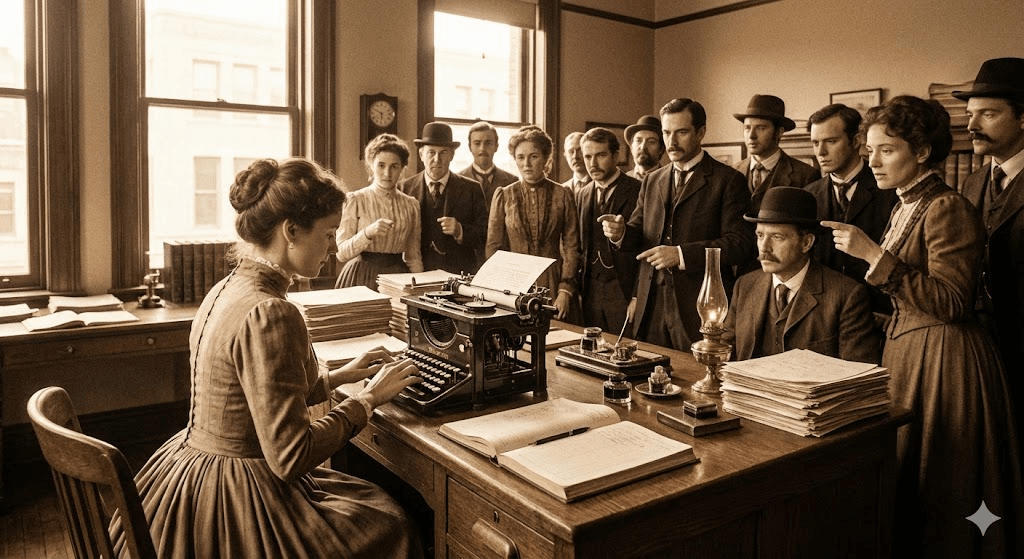
The introduction of the typewriter in the late 19th century marked a pivotal moment in the evolution of Washington, D.C.'s administrative landscape.
James O. Clephane, a prominent court reporter and stenographer in Washington, D.C., recognized the inefficiencies in transcribing legal documents by hand.
His pursuit of a more efficient method led him to collaborate with inventors, contributing to the development and refinement of the typewriter.
This innovation significantly enhanced the speed and accuracy of document production, addressing the growing demands of government administration.
The typewriter's impact was profound.
It standardized written communication, reducing ambiguities inherent in handwritten documents.
Government agencies could now produce clear and uniform records, facilitating better coordination and efficiency across departments.
In a city where precise documentation is crucial, this advancement was transformative.
Moreover, the typewriter's neutrality in content preservation ensured that the integrity of official documents remained intact.
It didn't alter the message but preserved it faithfully, a critical factor in a government built on deliberation and record-keeping.
As the federal government expanded, the need for consistent and scalable workflows became evident.
The typewriter enabled offices to grow without compromising clarity or efficiency.
Productivity became systematic, moving beyond individual capabilities to standardized processes.
Washington's modern administrative systems trace their roots back to this era when writing became operational.
The typewriter didn't change the principles of democracy but supported the daily operations that sustain it.
Reflecting on this technological milestone reminds us that institutional evolution often begins with better tools, not just bigger ideas.
In Washington, D.C., the typewriter was more than a machine; it was a catalyst for administrative transformation. |
0 Comments
Join the conversation
Be the first to comment
Share your thoughts above.